

How to Define Manufacturing Efficiency
First, you must define what manufacturing efficiency means to your individual firm. Consider this definition of production efficiency from Investopedia: “Efficient production is achieved when a product is created at its lowest average total cost; production efficiency measures whether the economy is producing as much as possible without wasting precious resources.” However, production efficiency in practice may mean something different for two different firms. For example, you may believe that production efficiency means that your production lines are completing more projects, and you relay that information to your employees. From then on, they understand that any bonuses or performance indicators are subject to that standard. By making that decision, you may see production output increase by a significant amount. But, you may also see an increase in defects and returns as a result. You must weigh what is most important for your business.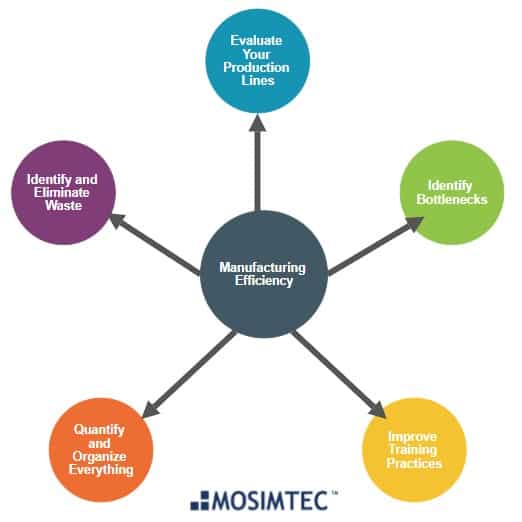
5 Ways to Improve Manufacturing Efficiency
Below, we explore five areas of your business that you can improve upon in order to improve manufacturing efficiency.4 Big Disadvantages of Lean Manufacturing - A Criticism of Six Sigma’s Approach
1. Identify and Eliminate Waste
Waste is a broad term. It can mean anything from employee hours, energy, materials, etc. Specific to manufacturing, one of the biggest sources is material waste. Here are a couple ways you can identify and eliminate ways:- Short-term: Identify material processes to catch excess material.
- Each of your processes creates some variation of waste. Identify which processes are creating the most waste and optimize them to bring waste down to an acceptable level.
- Short-term: Identify scraps and factory returns for recycling.
- Your excess waste can be recycled into new materials. Even if that isn’t the case, you could turn a profit by selling it to someone who can make use of it.
- Long-term: Create less waste with new operational practices and equipment.
- While identifying where you are creating the most waste, you will find operations that in the long-term, can be improved upon. This could mean anything from adopting new equipment that requires fewer materials to designing new parts that improve yield.
2. Evaluate Your Production Line
The production lines in your facilities are your bread and butter. Throughput is the most important metric to track when studying your production lines. It essentially measures the average number of units being produced over a specific period of time. This allows you to immediately identify problems in your production line when throughput is not up to par on certain machines. Additionally, you can track capacity utilization. By calculating what each factory’s total manufacturing output capacity is, at any given moment, you can see what production lines are performing at their highest possible output. Combined with throughput, you have two ways to track production line efficiency. To help identify the machines and operations that are slowing down both of these metrics, you may want to adopt simulation modelling as a business practice. Simulating the optimal performance of your production line will identify which of these processes needs improvement.3. Identify Bottlenecks
While identifying any problems in your production line, you will naturally discover your largest bottlenecks in production. Bottlenecks are the breakdowns in your production line, supply chain, or any business process that in turn prevents another process from accomplishing its function. For example, in a factory, a specific machine could require maintenance, shutting down its operation for half of a day. Any process that requires that specific machine to be in operation is then stuck, unable to perform. That machine is then the bottleneck. There are many forms of bottlenecks -- an admin who is needed for approvals falling sick is another example. Once you have identified your most common bottlenecks, you can work towards removing them and improving efficiency by eliminating excess downtime due to bottlenecks.How Can Simulation Improve Throughput and Eliminate Bottlenecks?
4. Improving Training Practices
How your employees function ultimately determines efficiency throughout your whole organization. Untrained employees equal poor efficiency and vice versa. Optimal employee performance starts with empowering every team member throughout the manufacturing process. This isn’t as simple as creating a booklet that someone trains off of -- highly effective workers require supervised, on the job training. But first, you must create standardized practices across your whole organization, from the top down. After all, you cannot expect each employee to be working efficiently when different managers institute different practices, and the same task is tackled multiple ways. Additionally, PWC suggests that in order to empower your employees to create sustainable efficiency, they should be asking themselves these questions:- “Is what I’m doing now adding value, or am I just doing it because this is the way I’m supposed to do this?”
- “If I were the customer, would I pay money for the activities that I am engaged in?”
Read More About Manufacturing Efficiency:
- How to Find (and Eradicate) Bottlenecks in Manufacturing
- 4 Big Disadvantages of Lean Manufacturing -- A Criticism of Six Sigma’s Approach
- Walmart’s Alphabot Powered by MOSIMTEC Simulation Consulting